


Perceptual Direction
A place is first felt.Then it is remembered.Then it is spoken of.
Perceptual Direction: the discipline behind every artwork we place
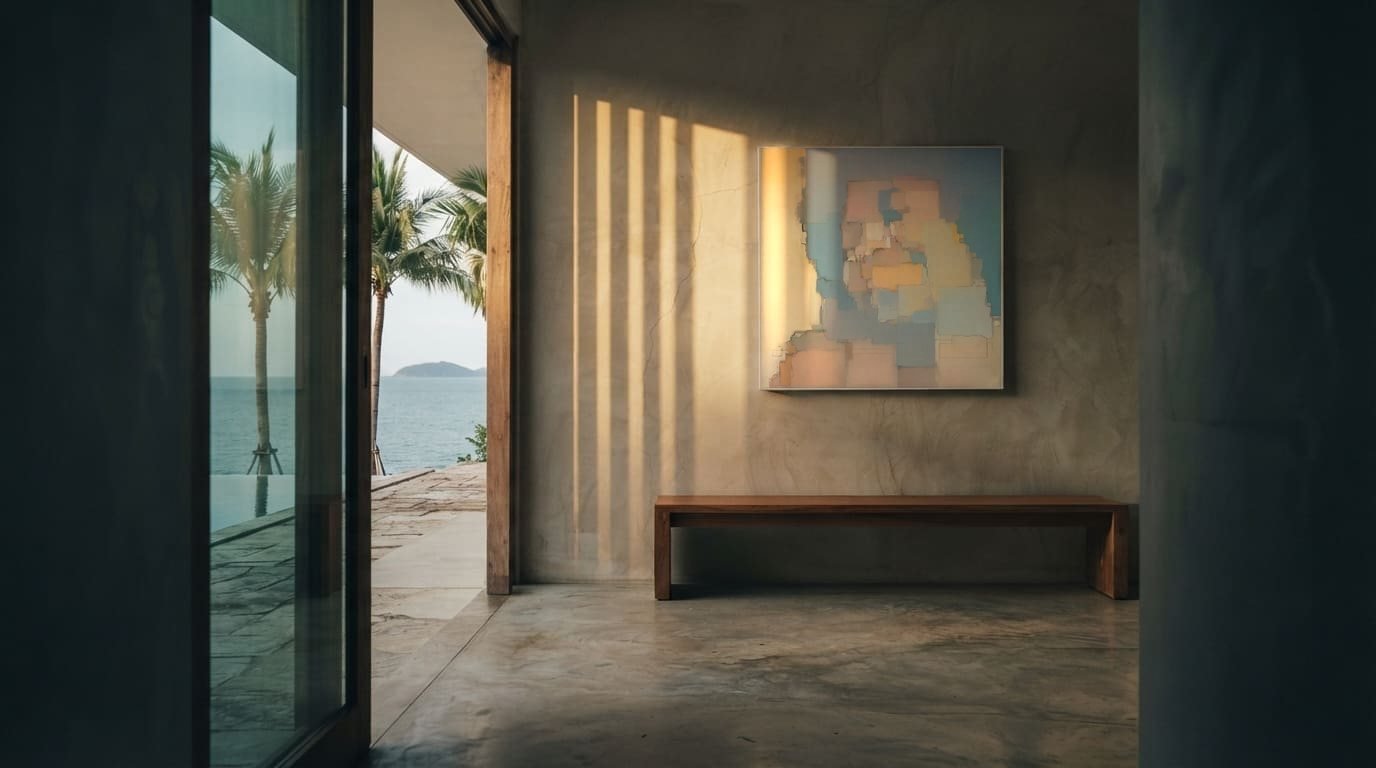
Illustration · Perceptual Artwork: Tidal Cognition, 90 × 90 cm
Scroll— The observation
Somethinghas flattened.
The high-end places of Southeast Asia have reached material excellence: noble woods, studied light, respected signatures. And yet, after a few of them, they begin to blur into one composite memory.
The gap is not in beauty. It lies between what the brief intended and what guests actually receive. It is small, often invisible, and it is where a place stops leaving a trace.
Closing that gap is our discipline. We call it Perceptual Direction: reading what a place should make felt, and directing everything that serves it, artworks first.
— Three words
Intention.Emission.Perception.
Intention
What the place is meant to convey: an emotion, a posture, a way of being received. Often written in a brief, rarely carried beyond it.
Emission
What the place actually conveys, through its materials, volumes, light, rhythm and silences. Never accidental.
Perception
What guests receive, and what stays with them once they have left. The only thing a guest takes home.
Every place carries an intention of its own: hospitality, calm, prestige, a sense of belonging. We help you choose the right intention, then we make sure the place truly serves it.
— Our ethic
We never choose an artwork because we have it. We choose it, or have it created, because the place needs it.
The place is never the experience.
The perception is.
— How we read a place
Perceptive Audit
We read the place as guests live it, from the arrival to the last image they take home.
Direction
Each artwork is given one task in the room: to hold the eye, to slow the pace, to carry a thread from one space to the next.
Sequence
A collection in a place is not a juxtaposition. It is a sequence guests follow without noticing.
— Informed by research
Our readings follow an internal method developed with the Perspicism research lab in Switzerland, and informed by research in environmental psychology and the science of perception.