

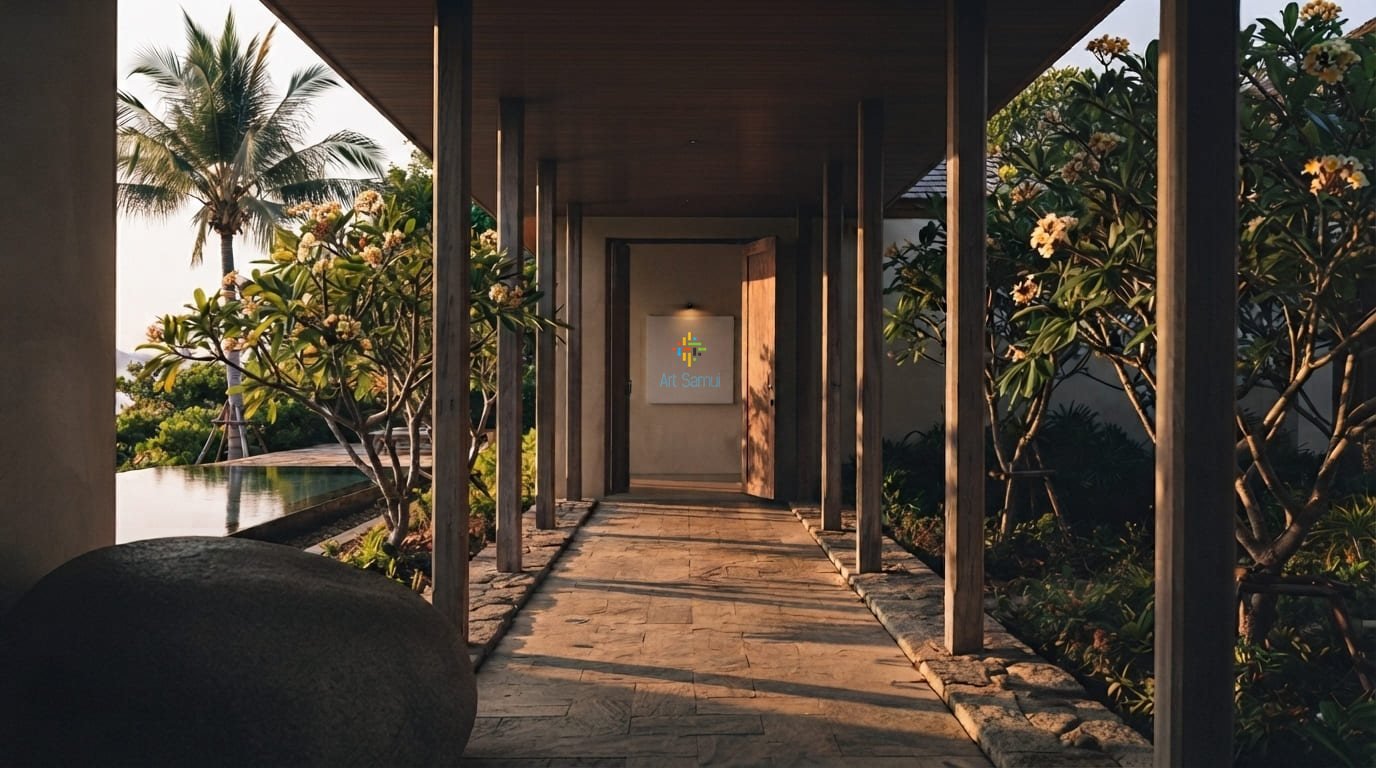
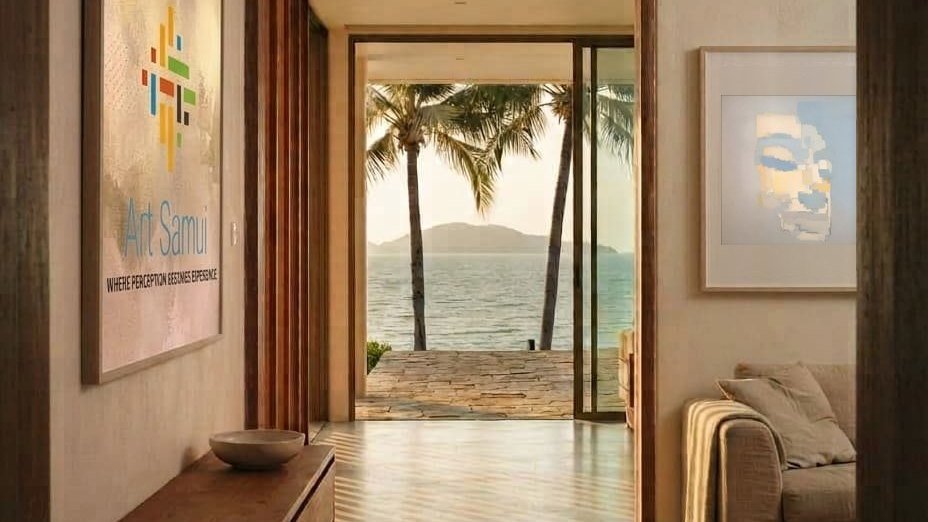
Spatial storytelling
Every place holds a story.Its spaces should let it be felt.
Spatial storytelling for hotels, villas and developments in Koh Samui
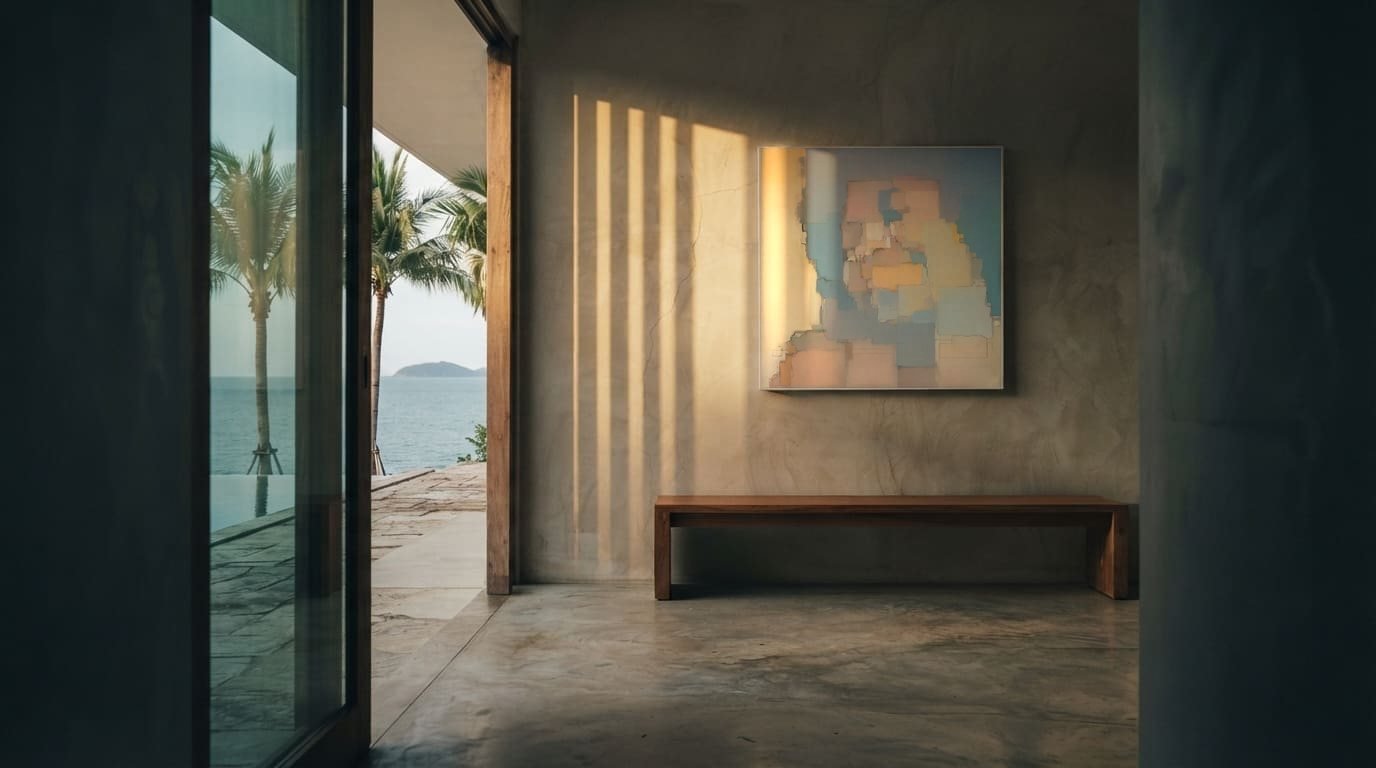
Illustration · Perceptual Artworks: Vertical Memory, Tidal Cognition, 90 × 90 cm
Scroll— 01
A story felt, not told
Every place worth remembering carries a story: the culture of a region, the history of a site, the idea behind a hotel, the life of a family.
Too often, that story is told rather than felt. It is written on a plaque, printed in a brochure, or reduced to a theme in the decoration. Spatial storytelling keeps the story and changes its medium. It is carried by the spaces themselves, by the order in which they are crossed and by the artworks placed along the way. Guests are never told the story. They live it.
— 02
Which story
Before anything is placed, we look for the story the place is already holding. It may be:
- 01The culture and heritage of a country or a region.
- 02The history of the site, of the land, of what stood there before.
- 03The concept of a brand, a hotel or a development.
- 04The story of the people who will live in the house.
The story is never invented for the place. It is found in it, then given a form that can be felt.
— 03
Heritage, without folklore
In Southeast Asia, culture is often reduced to decoration: carved statues, sacred figures used as ornaments, motifs repeated until they mean nothing. Guests recognise a theme. They do not feel a culture.
We work the other way round. A heritage is carried by what it is made of: its materials, its gestures of welcome, the way its houses open to the light and the rain, the rhythm of its days. Artworks suggest rather than illustrate. In our exhibition EMERGESCENCE, figures from Thai culture do not appear as images; they emerge slowly from abstract surfaces, for those who take the time to look.
— 04
Why the order matters
We never perceive a place all at once. We cross it: a threshold, a passage, a pause, an opening, a way out. Each space changes how the next one is felt.
Research on memory has long shown that we judge an experience largely by its most intense moment and by the way it ends, far more than by its average. A story told through space follows the same rule. What matters is not only what each room says, but where the sequence leads.
— 05
A story, imagined
Imagine a resort on Koh Samui whose story is the island's past as a land of coconut plantations.
- 01The arrival follows a line of old palms kept from the plantation, and the pace slows down.
- 02In the lobby, a single artwork holds the gaze, its palette drawn from husk, dry fronds and sea light.
- 03A corridor screened with woven panels filters the sun the way the groves once did.
- 04The room opens toward the sea, the route the harvest once took by boat.
- 05On leaving, a last image near the door, the one the guest takes home.
The word “plantation” is written nowhere. Yet the guest leaves knowing, without being told, what this island was.
— 06
Where it applies
Hotels and resorts
A culture or a concept felt from the drive in to the last image at departure.
→02Villas and residences
The story of a family, or of a land, carried through the day of a house.
→03Developments
An identity decided while the plans are still open, from the show unit to the shared spaces.
→04Spas and retreats
Healing traditions translated into a path toward rest, never into props.
→A place is remembered
in the order it is felt.
Tell us the story your place holds. We will show you how your guests can feel it.
Plan an appointment →— 07
What it changes
A place with a story felt in the right order is remembered as one experience. Guests remember not only how it felt, but what it was about, and they tell it in their own words.
A story rooted in one place, told in one sequence, belongs to that place only.
— 08
How we engage
Spatial storytelling is our most complete level of engagement: a fully narrated project, conducted alongside the architect and the operator, from the first plans to the opening. Depending on the scale of the place, it usually extends over six to eighteen months.
Every project begins with a reading of the place and of its story.
The artworks come last, never first. We never choose an artwork because we have it. We choose it, or have it created, because the story of the place needs it.